
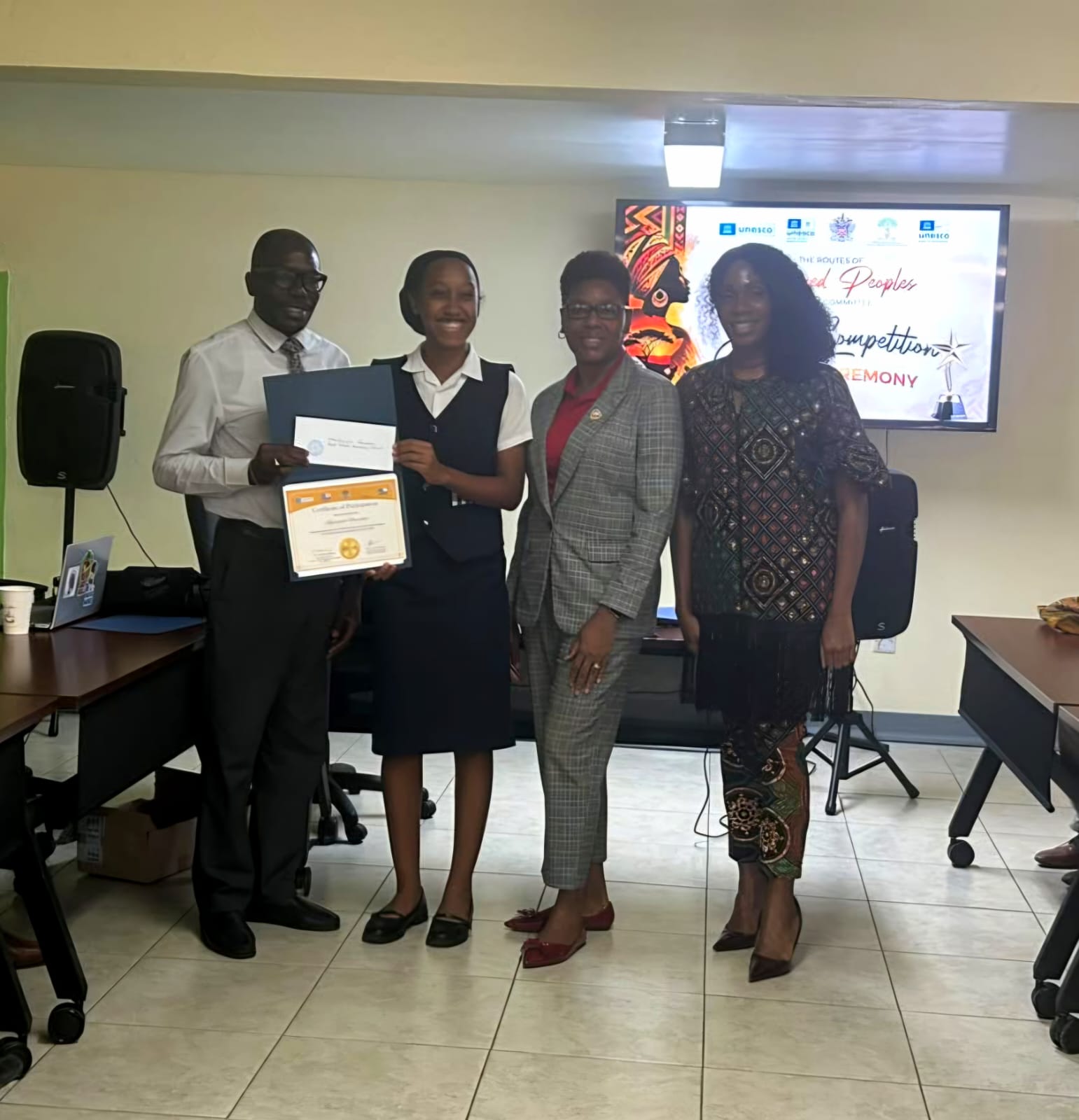
Basseterre, St. Kitts and Nevis, October 23, 2026 (UNESCO National Commission) – Yesterday, the St.Kitts-Nevis National Commission for UNESCO, in collaboration with the Ministry of Education, convened the prize-giving ceremony for the 2025 UNESCO Routes of Enslaved Peoples Essay Competition at the Early Childhood Conference Room.
The ceremony brought to a close the competition held under the theme “The Importance and Value of our Students Being Taught Their African Ancestral History” – an initiative designed to awaken consciousness and revive within the school system an appreciation for Kittitian and Nevisian history, heritage and culture rooted in African ancestry.
Six secondary schools participated: Cayon High School, Saddlers Secondary School, Charlestown
Secondary School, Basseterre High School, Washington Archibald High School and the Charles E. Mills Secondary School.
After a rigorous assessment, the top three winners were announced as:
1st Place – Ms. Markhailer Handley representing Cayon High School
2nd Place – Ms. Khalaylah Maccabbee representing the DLD Secondary School
3rd Place – Ms. Devine James representing Charlestown Secondary School
All participants were commended for the exceptionally high calibre of their submissions.
Delivering remarks, H.E. Nerys Dockery, Secretary-General of the St. Kitts-Nevis National Commission for UNESCO and Co-Chair of the UNESCO Routes of Enslaved Peoples Committee, stated that the competition was no ordinary essay competition, but an act of nation-building and self-reclamation:
“We wanted to drive home the point that the genesis of our Caribbean people of African descent did not begin in the belly of a slave ship but was birthed on the red soil of the great kingdoms and civilizations of Africa – in Ghana, in Songhai, in Mali, in Kongo – where our noble people were scientists, farmers, kings, queens, astronomers, mathematicians, architects and navigators.”
Secretary-General Dockery situated the initiative within the current global inflection point, noting the emergent and ascendant Pan-African movement demanding that history be told truthfully and that justice be served.
“From Accra to Addis Ababa to Bridgetown, Africa and its Diaspora are speaking with one voice for the first time in history. Led by the Republic of Ghana, H.E. President John Mahama is championing the international call for reparatory justice and has ensured that it has moved from the margins to the centre of global diplomacy.
The struggle for reparations is the defining cause of this generation. But how can our children claim
reparations for a crime they have never been taught? How can they demand repair for a history that has been hidden from them?”
She referenced the recent official State Visit of Prime Minister Hon. Dr. Terrance Drew to Ghana and Nigeria – including his pilgrimage through the ‘Point of No Return’ at the slave castle – and the official State Visit of President Mahama to Jamaica to the tomb of Marcus Garvey, as evidence of a new Atlantic bridge based on cooperation, kinship and international solidarity.
The Secretary-General emphasized that the Essay Competition is part of a broader push by the Routes Committee to support the Ministry of Education’s long-held aspiration to develop a comprehensive St. Kitts and Nevis Studies curriculum, noting that sustainable independence by 2040, as envisioned by the Prime Minister, cannot be achieved if national consciousness remains colonized.
“You cannot fight for a future you do not understand, and you cannot repair a past you do not remember. Now, more than ever, knowing who we are is not just cultural – it is political, it is economic, and it is justice.”
The National Commission expressed gratitude to H.E. Dame Marcella Liburd, Governor-General and the Hon. Dr. Terrance Drew, Prime Minister, for their distinguished patronage of the initiative, and to the distinguished judging panel comprising Ms. Carla Astaphan, Chair of the National Reparations Commission, Ms. Sheila Morris, acclaimed educator and historian, and H.E. Nerys Dockery.
In attendance were Mrs. Lisa Pistana, Permanent Secretary in the Ministry of Education et al, Mrs. Lisa Pistana, Permanent Secretary in the Ministry of Education, Mr. Francil Morris, Chief Education Officer, members of the UNESCO Routes Committee, teachers at some participating schools, parents, and students.
The UNESCO Routes of Enslaved Peoples Committee confirmed that this competition forms part of several initiatives aimed at decolonizing the national consciousness and preparing a new generation of advocates capable of taking their place in the global Pan-African movement.